Ohio Families Point to Trust, Mental Health, and Access as Keys to Improving Infant Mortality Outcomes
Updated: Sep 24
Groundwork Ohio webinar highlights lessons from families in four communities as state leaders look to build on progress in reducing infant mortality
Ohio has made significant progress in reducing infant mortality, but families across the state are identifying persistent barriers—from feeling unheard in health care settings to challenges accessing maternal mental health services and navigating economic pressures—that must be addressed to ensure more babies reach their first birthday.
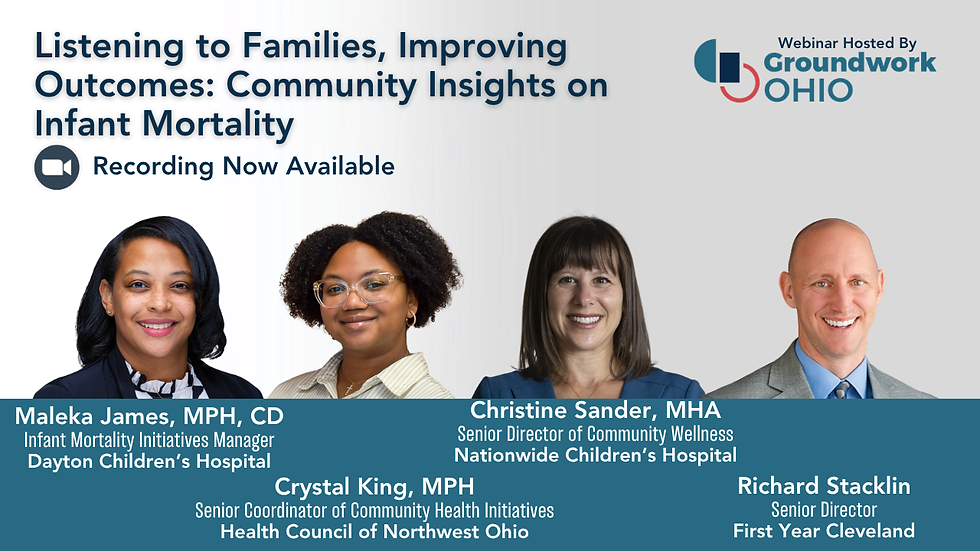
Those findings were at the center of Groundwork Ohio’s September 15 webinar, Listening to Families, Improving Outcomes: Community Insights on Infant Mortality, which brought together leaders from Montgomery, Lucas, Franklin, and Cuyahoga counties participating in Ohio’s Partner for Change initiative. The communities are combining data with listening sessions and other forms of family engagement to develop locally driven strategies for improving maternal and infant health.
Ohio’s latest data shows an overall infant mortality rate of 6.6 deaths per 1,000 live births, the lowest rate in the most recent 10-year reporting period. However, significant racial disparities remain: the rate is 5.1 for white, non-Hispanic babies, compared with 12.6 for Black, non-Hispanic babies and 6.7 for Hispanic babies. Black babies remain 2.5 times more likely to die before their first birthday than white babies.
“While Ohio has made progress on infant mortality, it didn’t happen overnight and it didn’t happen by accident,” said Caitlin Feasby, Managing Director of Policy at Groundwork Ohio, during the webinar. She pointed to more than a decade of bipartisan work that has included expanded Medicaid coverage, one year of postpartum Medicaid coverage, increased investment in evidence-based home visiting, and resources targeted to communities with high rates of infant mortality.
Ohio’s current state budget, House Bill 96, includes $36 million for infant vitality efforts over the biennium, including up to $5 million each fiscal year for community- and faith-based infant vitality efforts. Groundwork Ohio emphasized that continued investment will be important as Ohio prepares for a new governor, administration, and members of the General Assembly in 2027.
“The progress that’s been made belongs to Ohio,” Feasby said. “Our message to Ohio’s next generation of leaders is to keep going.”
Families Across Ohio Identify Common Challenges
Guest speakers from each Partner for Change community included:
Maleka James, MPH, CD, Infant Mortality Initiatives Manager at Dayton Children’s Hospital – representing Montgomery County
Crystal King, MPH, Senior Coordinator of Community Health Initiatives at the Health Council of Northwest Ohio – representing Lucas County
Christine Sander, MHA, Senior Director of Community Wellness at Nationwide Children’s Hospital, and director of the Ohio Better Birth Outcomes Collaborative – representing Franklin County
Richard Stacklin, Senior Director of Community Impact, Continuous Improvement, Evaluation, and Sustainability for First Year Cleveland – representing Cuyahoga County
Although each Partner for Change community approached its work based on local needs, several themes emerged across the four communities: families want to be heard and respected by health care providers, have stronger access to prenatal and postpartum care and mental health support, and be better connected to existing community resources.
In Montgomery County, Roots To Rise Dayton heard from mothers who reported feeling unheard or dismissed by providers, experiencing racism in health care, struggling to access prenatal and postpartum appointments, and lacking postpartum mental health support. The community identified respectful and empowering care, better access to prenatal and postpartum services, and maternal mental health as priorities for action.
“One of the biggest takeaways from Partner for Change is that the community voice cannot be something that we collect at the beginning of a project,” said Maleka James, Infant Mortality Initiatives Manager at Dayton Children’s Hospital. “Continue listening as the work evolves, and really create opportunities for families to shape the priorities, the solutions, and how we can hold ourselves accountable.”
In Lucas County, five Queens Village Toledo listening sessions and three community co-creation sessions helped identify maternal mental health and social support gaps, inequities in the health care experience, and economic and housing instability as key concerns. The community is now moving toward interventions focused on strengthening maternal mental health and social connection, improving trust and access in maternal health care, and addressing economic and social drivers of health.
In Franklin County, Ohio Better Birth Outcomes conducted 12 focus groups with 58 Black women who were pregnant or had experienced a pregnancy since 2021. Nearly two-thirds of participants reported experiencing a pregnancy complication, even though having a complication was not a requirement for participation. Themes included a lack of patient-centered care, changes to birth plans, the need for stronger advocacy and support, differences in care and treatment, and access to resources.
Christine Sander, Senior Director of Community Wellness at Nationwide Children’s Hospital and director of the Ohio Better Birth Outcomes Collaborative, noted that many of the concerns heard from women today closely mirror what Franklin County heard in qualitative research about five years ago.
“While we’ve made progress as a state and while we’ve made progress as a county, the fact that the same things or themes are coming up from women of color … is something that’s really resonating with our hospital systems and our key stakeholders,” Sander said.
In Cuyahoga County, Queen’s Village, led by Neighborhood Leadership Institute, conducted eight listening sessions with 40 mothers from five priority ZIP codes. Participants described anxiety during pregnancy, feeling overwhelmed postpartum, social and economic stressors, and mixed experiences with the health care system. The community’s top recommendation is to improve birth experiences for Black women by building trust, listening to patients, providing more individualized time with physicians, and strengthening culturally responsive care.
Turning Listening Into Action
Across all four communities, the webinar underscored that collecting family stories is only the beginning. Partners are using what they hear to shape concrete strategies, including strengthening maternal mental health supports, improving referral pathways, expanding community-provider dialogue, supporting doulas and other perinatal professionals, and creating ongoing structures for families to influence health care improvement.
The work comes at an important moment for Ohio. As the state prepares for a new administration and new members of the General Assembly, Groundwork Ohio is calling for continued collaboration and investment in maternal and infant health, with family voice and community experience helping guide those decisions.
“Continue investing in moms and babies, investing in the communities facing the greatest challenges, using data to hold ourselves accountable, and continue listening to families as funding and policy decisions are being made,” Feasby said.
News Coverage | Ohio advocates hope data plus relationships will equal better health for moms and babies, 91.3 WYSO, 9/24/2026